 Hello all!
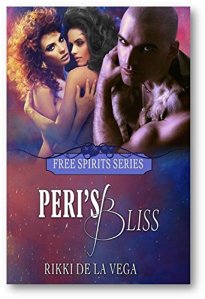
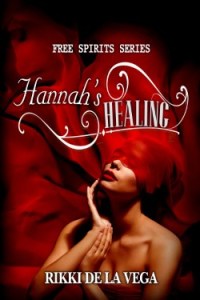
For this week’s Triple Play Q&A segment, I’d like to introduce you to Rikki de la Vega, author of Peri’s Bliss and Hannah’s Healing. I’m so excited to host her and to share her feisty, witty, inspirational responses with you!
Welcome, Rikki!
Rikki de la Vega lives, lusts and writes in Boston, Massachusetts. Polyamorous, kinky, and a feisty intellectual, she crafts her erotic tales from real-life experiences with the goal of presenting good smut for smart people. An unorthodox sex-positive feminist, she is also an online activist for everything from sex work decriminalization to disability rights.
Love it, Rikki—such a pleasure to meet you! And now it’s time for your Triple Play Q&A!
If you were a character in a book or series of books, who would you be and why?
My own character of Lila Jaworski, in the Free Spirits series, is one with which I identify. She’s vivacious, generous, and yet doesn’t need to be the center of attention to get things done. She also has a strongly intuitive sense of people, and none of the burdensome shame that so many have about sexuality and gender expectations.
 What writing project are you currently working on?
Right now, I’m writing Amalia’s Truth, my fourth book in the Free Spirits series. The series is set around members of the Free Spirit Connection, a fictional modern spiritual community which sees sex as another form of communion, even allowing members to get it on in private communion rooms. The title character in this book appeared previously, and in this book she’s attending the Connection’s Triennial Assembly as a delegate, not to mention having plenty of erotic encounters. But she also becomes the target of some unsavory rumors, and has to defend herself.
If you were to perform karaoke, which song would you pick and why?
Well, disclosure time here. I have a serious speech disorder, which makes it extremely difficult (even painful) to try to speak or sing for anything longer than a short sentence. So I let my friends do the karaoke thing, and I show my support to them by clapping and dancing. Anyway, if that weren’t the case, I’d be singing “Walking on Sunshine” by Katrina and the Waves. It’s so positive and high energy, you can’t help moving to the beat, feeling it flow through you. We need more of that energy, more talk about love and pleasure, less pettiness and “me-and-my-group-first” nonsense. And if you out there reading agree with me, do me a favor and sing “Walking on Sunshine” for me at your next karaoke night!
Well, Rikki, you’ve got it! “Walking on Sunshine” is officially on my next karaoke set list! Thank you so much for joining me today and for sharing more about yourself and your current projects!
If you’d like to find out even more about Rikki de la Vega, or would be interested in picking up some of her fantastic books, please click around the links above and below and go to town!
- Twitter: @RikkiDeLaVega
- Facebook: https://www.facebook.com/profile.php?id=100010916283466
- Website: http://rikkidelavega.wordpress.com

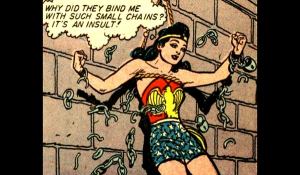 Okay, okay, I admit it – the title is total clickbait. After all, what could be hotter than Wonder Woman…and kink?? But now that you’re here, how about you take a gander and find out some fun (sexy) facts about Wonder Woman’s origins. And when I say “origins,” I’m not referring to Diana, Princess of Themyscira’s origin story, but rather to the man who created this goddess and gave the world one of its most recognizable, strongest feminist superheroes.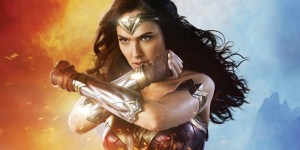
 Jaye Elise writes...